All CategoriesGamesSentinel Comics RPG › Struggling background

Struggling background

82 posts · 2492 views · started 2021-06-28 22:58 UTC
RA
Rabit
2021-06-28 22:58 UTC
#1

<Split from “How Exactly does Resolve work”>

Not disagreeing with the core of your statement, but I did want to point out something minor…

100% disagree. :blush: Some of us purposefully pick our background (and other choices) based on the character we have in our heads that we’re trying to create and not on the dice/stuff that they grant us. :wink: And that’s one I don’t think could really be “balanced” and still reflect that reality. :confused:

Not saying one way of approaching character generation is better than another. :wink: But I wanted to make sure you understand that different people build characters different ways, and I get the impression they are trying to accommodate as many folks as possible.

DJ
der_andere_Jan
2021-06-29 05:54 UTC (in reply to #1)
#2

Actually I agree - struggling can provide a very interesting narrative. What bothers me is that the said narrative translates directly into game effectiveness (=die size), effectively punishing the player (=not the character), which it shouldn’t. Commonly, you would expect a tradeoff that, while reflecting less resources, keeps playability in the balance. Like, offer more versatility (more of the small dice, an additional principle, a unique luck/improvisation schtick… whatever.)
As it is, it feels a lot like ‘you want to play a loser? Ok, you lose!’
Which means, as a player your choice will permanently weigh down the group; instead of being a different twist on a hero, your character simply is not much of a hero at all.

But this is most definitely a topic for another thread now :slight_smile:

CA
catDreaming
2021-06-29 08:34 UTC (in reply to #2)
#3

You are correct, that this is a topic for another thread. I will point out, however, that playing a struggling background character is far from making the character not much of a hero. I’m currently playing a character who is Struggling background and Training power source. They have exactly two dice on their sheet above a d8: One quality, which isn’t really used in combat, and their green status die. So you could argue that they are in fact at an even worse disadvantage than most Struggling characters.
They are very much a hero in their own right, despite their lower dice, and have proven to be able to hold their own in action scenes and social scenes. And more importantly… The lower dice don’t hold them back to nearly the extent you seem to be implying that they should.
Actually, maybe I should just share their sheet. So that you can see someone who is, in your words, not much of a hero.

Quick sheet errata though. Green Zone Ability Stimulus Strike should read as follows:
Stimulus Strike (A): Attack using Illusions. Hinder using your Min die.

RA
Rabit
2021-06-29 12:53 UTC (in reply to #2)
#4

Another thread, you say‽ :smiley:

Yeah, in my experience, SCRPG doesn’t have the kind of dependency on specific stats / values for a character to be “effective”, and most characters aren’t going to be more or less effective because they have a couple of dice that are lower than other folks’. :slight_smile: It might look like something of concern, but in play it hasn’t felt that way.

But that has just been my experience. Other folks might have a different experience, and I won’t invalidate that. :+1:t2:

MI
MindWanderer
2021-06-29 15:42 UTC
#5

It might not matter so much if the math of the game were different. But Overcomes in particular are a real problem for such a character. You have a 30% chance to roll an 8+ on a d10, a 41.7% chance on a d12, but only a 12.5% chance on a d8. If the best die you have is a d8, or even if you’re rolling 2d8+1d10, you’re going to be incurring a lot more minor twists, and being a liability to yourself and your team.

Combine that with the fact that you’re only going to be picking Struggling for roleplaying purposes, and more roleplaying-heavy games use more Overcomes and fewer combat abilities and, well… hopefully your GM goes easy on you.

FR
FrivYeti
2021-06-29 17:03 UTC
#6

So, how much you notice a die size difference of one step is going to depend a lot on what sort of actions you use. For ease of math and because I can’t do complex AnyDice functions, I’m going to use spreads of 3d6 against 3d10.

Overcomes: MindWander already covered this, but rolling 3d8 you’re looking at a 31% chance of a major twist, a 64.7% chance of a minor twist, and only a 4.3% chance of no twist. If you can use a Principle to use your Max die, you are instead looking at only a 5.3% chance of a major twist, a 61.7% chance of a minor twist, and a 33% chance of no twist.

If you have three d10s, your chances change a lot. Your chances of a major twist drop to 21.6%, with a 56.8% of a minor twist and a 21.6% chance of no twist at all. Get your Principle aligned and you drop to a mere 2.7% chance of a major twist, 31.6% chance of a minor twist, and a jump to a whopping 65.7% chance of no twist.

So, over the course of ten Overcomes using your Mid die and ten Overcomes using your Max die, a character with straight d8s is netting around 3-4 Major and 12-13 Minor twists, while a character with straight d10s is netting only 2 Major and 9 Minor twists. That’s a pretty big difference for a single die step.

Boosts and Hinders: In the case of Boosts and Hinders, I’m just going to quickly divide by Min, Mid, and Max and give you average results, because there’s a lot of math behind it.

On average, three d8s gives you a bonus of 1.25 with your Min, 1.73 with your Mid, and 2.27 with your Max. Three d10s gives you a bonus of 1.37 with your Min, 2 with your Mid, and 2.6 with your Max. So over the course of rolling with five each of Min, Mid, and Max, you’re looking at a rough total of 26 points of bonuses and penalties with your d8s, and 30 with your d10s. Not a huge difference, and probably low enough to vanish into the static if you’re not looking for it, but with the potential to mess things up.

CA
catDreaming
2021-06-29 19:38 UTC (in reply to #5)
#7

… Okay, am I the only person who doesn’t see Twists as a bad thing? Sure, they mean something isn’t going straight according to plan. But actions having consequences is part of storytelling.

As for Overcomes, here’s a few dice pools that I actually calculated the odds for. I wrote a program on my calculator a while back for getting the probability of any given min/mid/max combination on a straight roll of three given dice. Basically, the fact that there are three dice being rolled in a pool makes the math just a little bit complicated (and favorable) than examining any single die would imply.

d8/d8/d8: 33% chance of a Full Success
d8/d8/d10: 46% chance of a Full Success
d8/d8/d12: 55% chance of a Full success or better
d8/d10/d10: 57% chance of a Full success or better
d8/d10/d12: 64% chance of a Full success or better
d8/d12/d12: 70% chance of a Full success or better
d10/d12/d12: 76% chance of a Full success or better
d12/d12/d12: 80% chance of a Full success or better

Gee, those numbers might not look so good, huh? Remember though; You have hero points! To use your assumption that a roleplaying heavy game uses more Overcomes, presumably people in the party have been using Principles, and thus earning hero points. So let’s assume that you have a +2 hero point reward that you can use, to bump things up to a full success or better. How does that change the math?

d8/d8/d8: 75% chance of a Full Success
d8/d8/d10: 80% chance of a Full Success
d8/d8/d12: 83% chance of a Full success or better
d8/d10/d10: 84% chance of a Full success or better
d8/d10/d12: 86% chance of a Full success or better
d8/d12/d12: 89% chance of a Full success or better
d10/d12/d12: 91% chance of a Full success or better
d12/d12/d12: 92% chance of a Full success or better

Gee, that’s odd. It’s almost like having and using hero point rewards, the things that are supposed to reward you for roleplaying to your charater’s strengths, makes smaller dice not matter to nearly the extent you imply they should. Especially when just a measly +2 hero point reward is able to make a d8/d8/d8 dice pool pretty close to equal to an unboosted d12/d12/d12 in terms of avoiding Twists. I wonder if working as a team, and playing to Principles to get hero points, is meant to be a major part of the system.

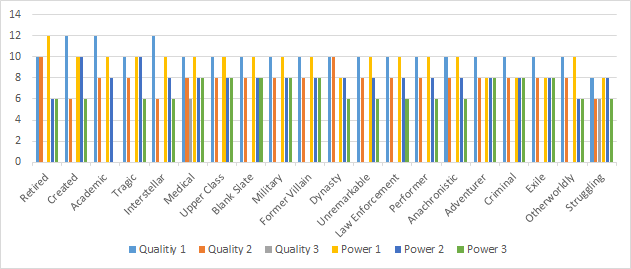
MI
MindWanderer
2021-06-29 19:42 UTC (in reply to #7)
#8

Yeah, that +2 bonus you can get at most two of out of the dozen or more so rolls you’re going to make sure helps a lot.

And yeah, twists are a bad thing. They can be used to develop storytelling, which is fine, but they can also deal damage, incur penalties, introduce challenges (which are the worst, IMO, because you either ignore it or you’ve effectively wasted your action because now another action is needed to make up for it). They can be interesting, but if you get a lot, your GM needs to tune down the difficulty to compensate, or else you’ll fail more scenes.

RA
Rabit
2021-06-29 19:50 UTC
#9

Two additional factors I think folks are also missing in this situation:

  • Struggling balances by giving you three qualities (instead of the usual two), letting you be involved / deal with more situations than other backgrounds do
  • You can also build your character so that the lower-die qualities aren’t key to your primary abilities/powers, and thus will be less likely to impact play. Yes, d6 mathematically is going to be lower than a d10, but are you actually going to need to roll the d6 most of the time? :wink:

Having said that, I don’t expect I’m going to convince anyone here. We’re really debating from different starting positions, which is fine. :slight_smile: We all have different ways of playing and focusing on the game, which can make things much more interesting! :smiley:

CA
catDreaming
2021-06-29 19:51 UTC (in reply to #8)
#10

Even without a +2, Major Twists are still very uncommon unless you are hindered. An unboosted d8/d8/d8 dice pool gives you a 5% chance of getting a Major Twist. If Twists are that big of a problem at the table, then as you said, the GM might need to change the difficulty of the scenes that they are designing.
I guess that I’ve gotten used to playing with lower dice pools on my characters, and as a result of that, I’ve learned to work around the limitations that you are suggesting they have? Pessimism doesn’t make the game more fun, and teamwork is intended to be a large part of the system as far as I can tell. Rabit hit it on the head that we’re approaching this from different positions, and probably aren’t going to convince one another.

MI
MindWanderer
2021-06-29 20:05 UTC
#11

Sure. It’s either “dice matter because you want to be successful” or “dice don’t matter because you want to tell a story.” It’s pointless to even argue because the goals aren’t the same.

FR
FrivYeti
2021-06-29 20:30 UTC
#12

catDreaming, would you be able to share your math? Because your results are substantially different than what AnyDice gave me for a d8/d8/d8 pool, which means that one of us has done something dramatically wrong.

For example, your unboosted d8/d8/d8 is giving out a 33% chance of a Full Success, whereas mine is giving out a 4.3% chance of a Full Success. That’s a literal order of magnitude or more difference.

FR
FrivYeti
2021-06-29 20:42 UTC (in reply to #9)
#13

These are both valid notes, but my counter-notes from my experience are:

  1. Struggling doesn’t only penalize your Qualities for that extra d6, it also penalizes your Powers, granting you a sixth die at d6 at the expense of stepping downfour other dice (three if you assume that Struggling is competing against the less powerful Backgrounds to start with.) I really like the idea of “have a few more dice, but they aren’t as strong”, but compare to Medic, which gives you three Qualities and also gives you a d10 each for Qualities and Powers.

  2. The second problem with Struggling is that it gives you no d10s for your Power Source, which means that half of your key Abilities are required to key off d8s and d6s. This is a problem that Struggling shares with four other Backgrounds, but they have d10 or d12 Qualities to balance that out.

WA
WalkingTarget
2021-06-29 20:49 UTC (in reply to #12)
#14

I’m assuming they were looking at Max die rolls instead of Mid.

If you’re looking at Mid and need a result of 8 on rolls of d8 that means you need at least two 8 results out of the three dice. There are only 22 results out of the possible 512 that have more than one 8.

CA
catDreaming
2021-06-29 20:56 UTC (in reply to #12)
#15

I was specifically looking at Max die, under the assumption at people were using Principles, as WalkingTarget correctly ascertained. It seemed like a reasonable assumption, although I will admit that it’s not always a correct one.

DJ
der_andere_Jan
2021-06-29 21:33 UTC (in reply to #11)
#16

In my opinion, both goals are an integral part of the game.
For the narrative part, the imbalance does hardly matter, and thus no problem at all - I totally agree with you there.

But another part of the game is also to quite mechanically overcome challenges and defeat opponents, and that is where die rolls do matter quite a bit. The fact that it is possible to mitigate the statistical disadvantage - by adapting your group logistics, or the GM simply giving you training wheels - isn’t really a consolation, because I think you shouldn’t have to, and it also seems quite unneccessary.

My trouble here, from the conceptual perspective, is that “what the character can do” and “what the player can do” are mixed up: Not all heroes are equal, and that’s intended. But all players should be - that’s where the idea of balance come in.

More concrete:
Of course, a (narratively) weaker character shouldn’t have the same grand manoeuvres at their disposal that a straightforward powerhouse brings - I think we can agree on that.
But it would seem quite easy to provide the player with a different set tools instead of simply cutting their options down; and most other RPGs I know do that in some way or other.

As an example - just to throw something in that’s maybe a little more creative than die sizes - you could maybe say “pick any two principles instead of the regular one” - that would reflect how a character has gone through a lot more formative experience than those with a straighter vita; and it would also provide a the player with a broader array of situations to use a Principle.

N.B.:
I suppose I would care much less if SCRPG wasn’t, at its core, a game setup I’m finding absolutely brilliant. It really shines in so many aspects that I want it to be as perfectly flawless as can be.
And it thus irks me all the more that there are those few parts that seem to blatantly say “ah, let’s not bother with tedious math; we’ll simply postulate balance doesn’t matter - that’s good enough, happy weekend everyone”.
It doesn’t really make the game less great by any means, but I still feel it would have deserved better, and the potential was so close!

MI
MindWanderer
2021-06-29 21:38 UTC (in reply to #16)
#17

Yeah, I feel exactly the same way. The core system is really smooth and elegant, but the content is a mess. That’s why I’ve been screwing around with a homebrew system for a while that takes the SCRPG system and puts everything I want mechanically in it. Wish I had the time to put more work into it… or the friends who would actually play it with me and give me an incentive.

TJ
The_Justifier
2021-06-29 23:02 UTC
#18

Not familiar with the SCRPG in particular, but I think there’s enough on this topic that I can weigh in on from just a general RPG-and-cooperative-gaming perspective.

When the game is about everyone collectively achieving an objective of any sort beyond just amusing each other with Monty Python quotes or lame Dad-joke-tier puns (possibly about trains, but either way), that brings with it a certain degree of shared responsibility. (I get very tired of people abusing that phrase, as it’s a commonly-resorted-to one in this day and age, and frequently used for some extremely cringeworthy government propaganda, but I think it’s applicable in this case.) If someone is in the mood to intentionally saddle themselves with a handicap, “because that’s how I’m playing my character”, that can potentially damage the fun of other people at the table. If I’m sitting down to a game of Enhanced Edition SOTM, I might be willing to just go up against Baron Blade and let everyone else do whatever they feel like…but other times, I might be going “oh I just bought Wrath of the Cosmos and I hear Progeny is super hard, I really want to try him out”. And if one of my fellow players then decides they want to play Setback or Guise and be a total goofball the whole time, and it ends up costing us a victory which we could have achieved if they hadn’t messed us up…it is not okay that that one person got to achieve their goal of having some silly fun, when it completely destroyed three other peoples’ desire to earn a victory over an extremely challenging foe. The same principle applies in an RPG scenario, if that scenario is even somewhat focused on combatting a foe or otherwise achieving an objective.

This modern attitude of “oh just do whatever your character would do” is not the ultimate answer to everything which it is often treated as being.

CA
catDreaming
2021-06-29 23:38 UTC (in reply to #18)
#19

I understand the sentiment that people have a responsibility to bring a playable or appropriate character to the play table. However, speaking as the person playing a character with said ‘handicap’, I don’t think that you lack of experience is helping. Despite what this thread has been implying, a Struggling background character is far from unplayable or inappropriate in the majority of cases. And in the SCRPG, unless you’re in a one-shot, everyone knows what everyone else is playing beforehand.
In addition, there aren’t that many Backgrounds that give access to Respnsibility Principles. Four, out of the twenty, to be exact. There are only three Archetypes, another thing selected during character creation that can give access to Responsibility Principles. Believe it or not, most of the options that offer Responsibility Principles? Tend to be just as limited as Struggling, albeit with slightly better dice.

That concept of bringing a playable character? Struggling characters are just as playable as any other. And if you don’t want anyone’s character to be Struggling… just don’t make it an option during character creation. Surely for a higher power game, pruning options during character creation would make sense?

RA
Rabit
2021-06-30 01:43 UTC
#20

Question: have other folks played a character with the Struggling background? Because I haven’t seen it be an issue when I’ve had folks play it, and with the exception of catDreaming, I haven’t seen anyone talk about the experience – just the theory. :confused:

Not saying this proves anything, but it is usually good to get actual data for these situations. :grin:

DJ
der_andere_Jan
2021-06-30 09:45 UTC (in reply to #20)
#21

It’s hard to argue with that :smiley:

Out of curiosity, how did they handle Overcomes?
Assuming a Principle is used, and also assuming the Zone die is equally a d8, a 8-8-8 pool has a chance of roughly 33% of a flawless success, while a 10-10-8 pool is at 57% - that seems like a vast difference; mostly because the ‘8’ mark is right at the upper limit for the d8.
I am aware that twists aren’t a bad thing per se, but they still add complication that needs to be dealt with…

Maybe the psychologie works the other way round: I know that I myself was toying with many a character that would start off struggling, and many of the responsibility Principles lend themselves to very sweet narrative hooks.
But I’ve seen myself constantly hesitating because of the bad dice perspective, and swerve off to law enforcement (good dice) or even Upper class (great dice) - compromising my concept for that. Or going to Unremarkable and shoehorning the character into Marksman, compromising again. Or mitigating by deliberatley picking MIN die abilities, forcing my hand even more… and getting one lonely decent die from the Source step seems to make for a sad one-trick pony.

In theory, that is. :wink:
I’d love to hear more about how your group handles the (mathematically existing) challenge of a weak-die member.

SL
Slickriptide
2021-07-01 18:21 UTC
#22

Headlong, the ostensible leader of Daybreak, the “first time players learning group”, is a “struggling” character.

I’d be curious how many people played through the Stolen Legacy/Urban Infestation modules and felt like he was some sort of “drag” on the team?

RA
Rabit
2021-07-01 18:54 UTC (in reply to #22)
#23

Thanks, Slickriptide! Great catch! :smiley: I never even noticed that. :smile: I’ve run Urban Infestation at cons quite a few times and never felt like Headlong was less effective or had anyone raise a concern as Headlong’s player. (Can’t say that is going to be everyone’s experience, though, so take that for what it’s worth. :wink: )

(And apologies for not replying, yet; I’m trying to get the character sheet for instance I GM’d to provide context for my thoughts. :relaxed:)

SL
Slickriptide
2021-07-01 19:24 UTC
#24

I can’t help feeling that the “Struggling = Bad” position in this discussion is a “you gotta min/max all your dice or you’re failing as a player” position. Maybe I’m misconstruing the arguments.

“Struggling” gives a hero a choice of three of “Banter”, “Underworld Info”, and/or “Physical Traits” and assigns d8, d8, d6. How frequently is a d6 in Underworld Info ACTUALLY going to matter to overcoming an obstacle in a dust-up with super-villain minions? If the “struggling” character has a d6 in Stealth and no other characters in the group have Stealth at all, isn’t that better than nothing?

It seems to me that all of this talk about min-maxing your dice and only pulling your weight if every die on your character sheet has the maximum possible number of sides (so that you can make sure you overcome any imaginable challenge) is missing the bigger holistic picture of the character’s entire profile of powers and qualities, as well the general point of the game which is not to crunch numbers but to create a collaborative story.

This line of thought inevitably leads down a road where you can only take certain powers, because other powers have smaller or fewer dice, and you can only take certain backgrounds, because others are “weaker” or “limiting” and the game becomes about “solving” character creation instead of about realizing the character you want to play.

Well, I suppose for the min-maxer, the “SuperDuperMan who is immune to all damage and handily defeats every single challenge he comes across” might actually be the sort of hero he wants to play, but personally I’d find it a bit boring to be that guy’s sidekick.

DJ
der_andere_Jan
2021-07-01 22:26 UTC (in reply to #24)
#25

Well… while you’re certainly not all that wrong, there’s a bit more middleground between min-maxing and completely ignoring probability levels. :slight_smile:

It’s actually d8, d6, d6. And then another d8, d8, d6 to carry over to the Power Source step, where you get a large part of your Powers and Abilities keying off those powers.

I certainly don’t mind a spread of various skills. But on the other hand, I’d say there are moments when you are best off playing to your probabilistic strengths; and in those situation it might help to actually have any…

Also, I’m not saying it is impossible to play - what I’m saying is lower probabilities makes things mechanically harder to overcome.
If those who played a Struggling character say that this isn’t really an issue, all the better!

Still, I’d like to point out that Headlong specifically is built with the Relic Power source, which is special in that it gives two d10 for the Archetype step. His defining Power, Momentum, is then built upon that last step. And, interestingly enough, almost all of his Abilities key off Momentum; which shouldn’t even be possible through a regular building process! So actually Headlong does not really suffer the limitations of Struggling; in my book he is rather a showcase of the need for deliberate workarounds (including cheating) to make it work…

Let me re-iterate:
I absolutely think it is possible for a struggling character to generally pull their weight. But mathematics tell that if you ever roll dice, at least some extra effort (be it during chargen, by the hero group dynamics, and/or by the GM adjusting) will be needed to mitigate the weak starting point.

And what irks me about that is not that it generally exists - but that it seems like a situation that easily could have been balanced in the first place (and I’m absolutely not saying it must be balanced by dice availability; myself I think I’ll stick with the extra Principle idea to toy with).

CH
Chaosmancer
2021-07-01 23:14 UTC (in reply to #19)
#26

I’m sort of just jumping in here with a thought. But is there an advantage to having Responsibility Principles that would justify this? I haven’t looked over them very closely, so I’m not sure.

It might end up mattering though, because unless the players are rolling for their character… I just let people pick what makes sense for their character. I’ve only had a very limited number of characters created, but I didn’t feel any need to limit them to which Principles they could grab. Because sometimes there is a principle that makes sense for the character, but was in the wrong section for you to pick it.

SL
Slickriptide
2021-07-01 23:22 UTC (in reply to #25)
#27

Thanks for the correction!

I think the worst you could say about Headlong is that he was built using “constructed” rather than “guided” instructions. Otherwise, his character sheet looks legit to me.

Now, it’s true that Headlong is tailored to the use of his signature power, but isn’t that going to be true for any character, especially a character whose minor characteristics are weak in comparison? There’s nothing about Headlong’s description that would lead one to believe that Underworld Info is central to his character. His brother was the drug dealer and that’s the extent of it as far as Headlong is concerned. There’s nothing to suggest that there should ever be a reason for Headlong, as a character, to ever be in a position where he would be using that quality to overcome a challenge unless it was the only possible choice he had.

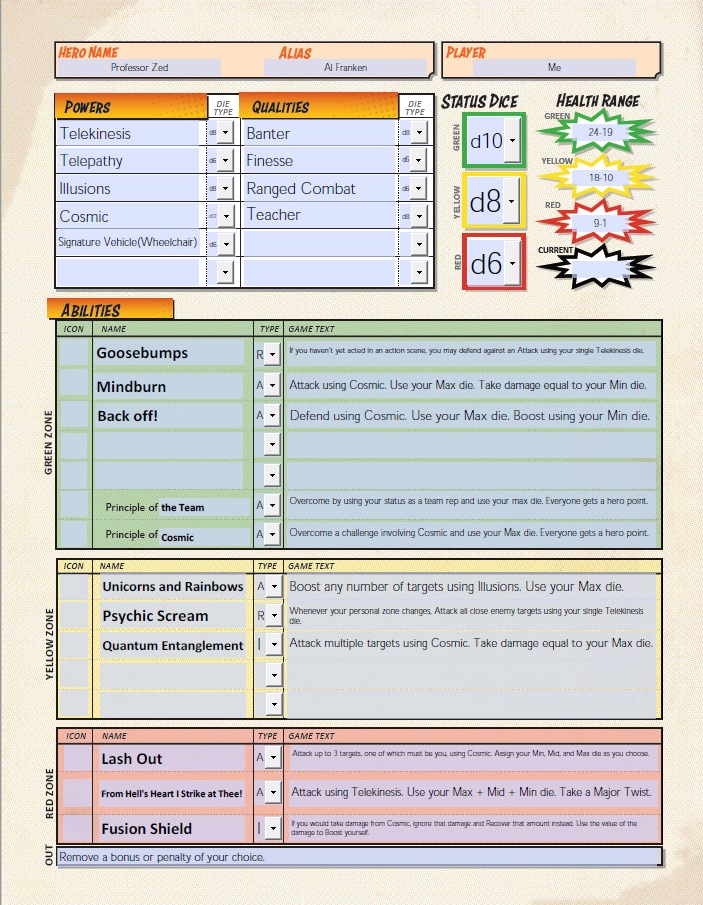
Let’s say that I made a Professor X character and chose “Struggling” to represent the fact that he’s wheelchair bound and even went so far as to assign those low-valued dice to three physical traits. I don’t think it would be “cheating” to turn around and make sure that my main powers were all built around Professor Zed’s fantastic mental abilities.

Headlong is a “transporter” who isn’t likely to ever draw upon his underworld knowledge and if he’s bad at banter, that’s mainly a role-playing attribute anyway. Looking at it strictly from a dice-sides aspect is ignoring the way that the game allows one to tailor around a potentially debilitating choice and still make a useful hero anyway. That’s a feature of the game.

The plain truth is that Headlong is almost never going to be in a position to make an overcome roll on his “struggling” skills, so the math really doesn’t enter into the picture.

Though, of course, the GM could take note of this particular weakness in Headlong’s character sheet and deliberately PUT him in the position of leaning on those underdevloped skills but that’s still story taking precedence, IMO.

RO
Ronway
2021-07-02 02:17 UTC (in reply to #25)
#28

There is no cheating. Momentum was taken at a d6 at the Relic stage. Transporter allows someone if they have a Mobility power to swap one of the dice for Archetype for the previously chosen Mobility power. So he swapped it for the d10 and then the d6 was then used to pick Speed.

DJ
der_andere_Jan
2021-07-02 05:11 UTC (in reply to #28)
#29

That makes sense.
I withdraw my accusation of cheating!
But then again, if that isn’t an example of carefully constructing most of your abilities to key off your single best die I wouldn’t know what is. :slight_smile:

RA
Rabit
2021-07-02 11:44 UTC (in reply to #29)
#30

You… say that like it’s a bad thing. :smirk:

In all sincerity, if a character’s concept is based around one fundamental aspect, then it’s likely going to focus on that. :man_shrugging:t2: It’s up to the GM to put the PCs into interesting situations that can challenge the characters in fun ways, help them find interesting ways to work through those situations, etc. (“Sure, I can manipulate friction to move quickly, but how does that help now that I’m stuck in this weightless environment where friction is irrelevant‽”) But a character concept is frequently focused around a specific power, so that will likely have the best die (unless there’s a quality the player sees as being more fundamental to the character, like Schmeed Schmichards’ intelligence/science versus his ability to stretch).

Is that abnormal to the experience of others? :confused:

OD
OddballPaladin
2021-07-02 13:43 UTC (in reply to #11)
#31

A bit. I have a knee jerk reaction against the “dice don’t matter” crowd because of many years in games under GMs that felt that PCs that were useless or underpowered were “better” for the story. Not saying they’re the same, but that’s where I’m coming from.

I’m not an optimizer or munchkin, but I do want my characters to feel like they’re competent. Twists are not necessarily bad, but if you’re getting twists all the time, you’re going to be a burden at the table, and if the choice is always “failure or bad/annoying/complicated stuff happens,” then I as a player am going to be asking why my character is even in this situation.

To cross game genres, escort missions are the bane of action and RPG games for a reason.

RA
Rabit
2021-07-02 13:59 UTC (in reply to #31)
#32

Ah, sorry you had to have such a poor GM experience like that. :pensive: (Not saying your GM was bad, of course. I’ve made significant mistakes myself, so no judgement! :smirk:) Definitely an understandable reaction.

I don’t fully agree with MindWanderer that it’s one of the other, as there’s significant nuance in how it is handled. One of my current campaigns (non-SCRPG) has folks who are power gamers want all the high stats/powers and folks who truly don’t care about their stats in the slightest. (One person is hovering in the middle, but they’re in it for the socializing so they’re pretty easy to appease. :wink: ). I have to balance that in the gameplay/challenges to ensure everyone is getting their opportunity to shine in the way they prefer.

In my opinion, it really does come down to everyone at the table understanding each other and their characters, and finding ways to make the game fun for everyone. If the GM is not taking into account that PC1 has high dice they’re going to use most of the time and PC2 has their dice scattered across a bunch of lower numbers when they come up with the challenges, they’re kinda failing to ensure the group is going to have fun – unless PC2’s player wants to frequently have significant challenges but PC1’s player wants to always be awesome… :wink:

SL
Slickriptide
2021-07-02 16:56 UTC (in reply to #29)
#33

But then again, if that isn’t an example of carefully constructing most of your abilities to key off your single best die I wouldn’t know what is. :slight_smile:

But… what’s wrong with that? Isn’t that what a min-maxer is going to do anyway in order to maximize opportunity?

As it stands, every choice is going to be “sub-optimal” in some way. I started building “Professor Zed” using the guided method (though I started with “struggling”, as that’s our discussion here) and in order to get Psychic powers, the dice gave me a choice of Accident (d12/d6) or Mystical (d10/d8/d8). Psychic is Professor Zed’s signature ability, so why on earth would he choose any power that requires his “struggling” physical prowess? THAT would be deliberately hamstringing your own character, which was the original complaint about “struggling”.

Now, as a min-maxer, the game forces another choice on me here. Take Accident and get the no-brainer “godlike” d12 on my Telepathy or Telekinesis or whatever and the mediocre d6 on something else, or take the more consistent (from an overcoming standpoint) but less powerful dice from Mystical and get more powers as well. It’s not a clear-cut choice.

Anyway – it seems to me that your objection about the math is coming from a standpoint that all abilities/powers matter equally; particularly since you specifically call out the tailoring of a character towards her strengths as “cheating”. That’s simply not going to be the case, though. In fact, strengths and weaknesses are the very reason you need a team in the first place. You support each others strength and shore up each others weaknesses. I took four years of Spanish in High School but if I needed to talk to a native Spanish speaker today, I’d get a really fluent translator rather than try and overcome it with my lousy “d6 Spanish fluency.” If Professor Zed absolutely had to fire a gun or hold up a falling concrete pillar with his hands, I expect that to be major twist situation that he’s probably going to fail. If my teammate was opining about my choices in backgrounds I’d be asking why SuperDuperMan isn’t over here holding up this thing instead?

The only way that “struggling”, or any other origin, becomes a detriment to the team is if that player deliberately designs his character to have NO strengths, which I’m unsure is even possible. Uh, what was the kid who hung out with Man Thing, whose “superpower” was that his luck was so phenomenally bad that his whole life was terrible and Man Thing was his only friend? That’s the kind of character you’d have to deliberately build in order to consistently drag down your team by your build. You’re not going to get that just by choosing a “sub-optimal” background over a “most optimal dice” background.

TJ
The_Justifier
2021-07-02 17:08 UTC (in reply to #11)
#34

The problem is that this is kind of a false dichotomy, in that your telling of a story can be hampered by what the dice are doing. If you’re playing a character who is supposed to be super-strong, but your strength die keeps rolling low, then the dice are changing the story of your character from “strong guy who always performs feats of strength” to “supposedly strong guy who actually keeps failing, and will eventually get a reputation therefore”.

SL
Slickriptide
2021-07-02 17:11 UTC
#35

Not to pound a dead horse into the ground, I’ll just point out that Peter Parker is basically a “struggling” character for most of his early career but you wouldn’t find many heroes in a dustup wanting to kick Spider Man off the team because of it. It would be a little silly to complain that he was cheating by tailoring his build around his web-slinging/wall-crawling abilities instead of his “can’t hold a straight job” qualities.

MI
MindWanderer
2021-07-02 17:43 UTC (in reply to #35)
#36

Okay, now that’s ridiculous. It’s not like Spider-Man was created using the SCRPG system. He doesn’t have d6’s and d8’s. He does have super-strength, super endurance, wall-crawling, danger sense, and a whole bunch of gadgetry, plus a tremendous amount of skill with science and technology. He’s hugely valuable on a team.

Besides, heroes would never kick a “weak” member off their team anyway. Superhero teams are formed by expedience and interpersonal bonds, or are put together by a third party. Their power level has nothing to do with it. (Also, this is comic books. As someone pointed out, Batman can either go toe-to-toe with Darkseid or get bloodied by a random thug depending on context.)

CH
Chaosmancer
2021-07-02 18:38 UTC (in reply to #30)
#37

I wouldn’t say it is abnormal, but I could see it feeling… artificially stifling. Like, it feels like struggle forces you to find a way to get a single really good die and then build everything around that die. While there are a lot of other routes you could take that don’t give that same feeling.

It could also be said that part of the issue is thinking about things in different orders. If a player wants to play a poor character, they should pick struggling, but that limits their dice in a way that seems noticeable to some players, and begins focusing them on trying to be a character with a singular focus on the one good die they can get, locking them into being a character with this single major focus.

Meanwhile, there are people who don’t care about the dice at all, and also people who start wanting a concept where the character has a single major focus and then it doesn’t hurt them to be struggling, if they decide to go that way.

And if the player doesn’t want that story?

I’ve been the guy behind the dice who are telling a different story about my character than I want to tell. It isn’t a good feeling.

I’m not trying to say that the dice must always follow what I want, but I’m leery of any advice that dismisses what I actually want from a character in favor of random statistical averages.

CH
Chaosmancer
2021-07-02 18:41 UTC (in reply to #32)
#38

I want to zoom in here really quick.

Other than making sure that PC2 has easy access to boosts… what is the DM supposed to do if they don’t want significant challenges?

Unlike a game like DnD, Sentinels doesn’t have scaling DCs that you can obscure to manipulate the situation. And there is no way to get permanent buffs. So what levers would you pull and twist to help PC2 in that situation?

CH
Chaosmancer
2021-07-02 18:55 UTC (in reply to #33)
#39

Um, I think part of your confusion might be that you are might have misunderstood character creation. Maybe not, but the way you presented this it feels like that is the case.

When you picked struggling you got 1d8 and 2d6 to put on Qualities.

You then rolled 2d8 and 1d6 to get your power source (either accident or Mystical)

Those are the dice you are putting into your psychic abilities. At this stage there is no choice between 1d12/1d6 or 1d10/1d8/1d8. You either are delaying your psychic powers until your archetype (and hoping to role one that gives you that option) or you are hoping for a way to swap it (maybe using your retcon at the end)

This is the issue that was being talked about, your first set of powers HAS to be 2d8 and a1d6, and you already have 1d8 and 2d6, meaning you are sitting with 3d8 and 3d6 by the time you are getting to your archetype, and hoping to find a way to use your last section of character creation to utilize a die bigger than a d8. Depending on your Archetype, it is impossible for you to use that 1d12 from Accident on your psychic abilities, and a chunk of your yellow and greens are d8’s and d6’s

SL
Slickriptide
2021-07-02 20:22 UTC
#40

Yes, you’re right. This business of the dice on a chart being things you apply to the next chart rather than to this chart is confounding. :exploding_head:

Given that, I’m willing to acknowledge that you’ve got a bit of a point. Let me try rolling up Professor Zed again and see what happens.

TJ
The_Justifier
2021-07-02 20:44 UTC
#41

Now that’s ridiculously untrue. Some super-teams wouldn’t kick a member off, certainly, but not every hero team is equally a paragon of noble principles. Look at the Fall of the Prime Wardens story. Those heroes all had reasons to turn against each other, but if only one of them had been guilty of the things that instead they were all guilty of, it’s absolutely possible to believe that the guilty one would be expelled rather than the entire team separating. Likewise, if a character as dangerous to be around as Setback or The Harpy were in a team that wasn’t either the ragtag-misfit group of Night Watch or a paragon of righteousness on the order of the Legacy-led Freedom Five, they might easily given the boot simply because they’re not able to contribute, or they cause more harm than good. In particular I imagine the Freedom Six in the Iron Legacy timeline, and think of someone like Harpy trying to join the team along with Tachyon, and TLT having to say “Look, there’s too much at stake here, we’re all dead if we fail, so we can’t take the chance of including you and possibly having you suffer an episode at a critical moment.”

MI
MindWanderer
2021-07-02 20:47 UTC (in reply to #41)
#42

I think you only read half my sentence there. The Prime Wardens didn’t have any problems with each other not being powerful enough, they had interpersonal conflicts. The rest of your argument is sheer speculation. And it doesn’t have to do with their power level, either, but their unreliability.

TJ
The_Justifier
2021-07-02 20:52 UTC (in reply to #42)
#43

Okay, so let’s pretend that Setback does all the things he currently can do, with none of the downsides, but also no additional upside. (I don’t know SCRPG mechanics, so I can only look at his SOTM deck; in terms of that deck, you’re basically taking his Risk power away and not giving him any other power in its place, along with taking away some portion of the Unluck mechanics, I’m not quite sure how you’d do it.) When everyone else is firing on all cylinders, and you’re just half as useful as everyone else, but your presence is still increasing the value of H (or whatever the equivalent in SCRPG is, something akin to the Challenge Rating system in D&D), then it’s absolutely a legitimate cost-benefit analysis to just say, “Sorry kid, you’re not worth it to us.”

MI
MindWanderer
2021-07-02 20:56 UTC (in reply to #43)
#44

Now that’s going into deck mechanics.

Story-wise, if you took away Setback’s luck powers, he’s still super strong and tough—on par with Legacy. He’d also finally be in a position to learn and improve his skills; he’s expressed interest in doing that (Mr. Fixer has tried to teach him martial arts) but his bad luck always gets in the way.

So yeah, lots of superhero teams would be plenty happy to have him on board.

TJ
The_Justifier
2021-07-02 21:01 UTC (in reply to #44)
#45

According to C&A, Setback is about half as strong and tough as Legacy, plus he can’t fly and doesn’t have keen vision and doesn’t have a supernatural danger sense (that part’s actually pretty damn important; one thing that Cracked.com once pointed out is that the thing which really makes a superhero possible is the power to do everything right, that the main reason why vigilantism is illegal in real life is that a person who thinks they know what should be done about a situation is often wrong, and makes things worse through their incompetent intervention). So while a lower-power team might be okay with his presence, a group on the level of the Prime Wardens would not want him around, since his weakness would make him a liability and they’d have to hamper their own efforts in order to protect him and carry his share of the weight. Most likely, they wouldn’t want him to join at all, but if he tricked them into letting him join, and then his uselessness became obvious, he absolutely might be kicked out.

SL
Slickriptide
2021-07-02 21:59 UTC
#46

So, here’s Professor Zed (who by rights ought to be an Academic but we’ll let that go for now).

Part of what’s going on here is that the Guided method leaves one with some odd choices at times if one already has a concept in mind. (Professor Zed would make a lousy close combatant, I’m thinking, Dice…)

I can sort of see the point, here, but on the other hand, the charts offer ways to balance things out. Like, for instance, a d12 in Accident leading into an Energy Manipulator archetype. So, now Professor Zed is an astronomer who got hit by a crazy meteorite and sure, he’s all paraplegic but he’s also bursting with Incredible Cosmic Power!!!

So he’s kinda average to mediocre on the psychic front but he’s pretty badass on the zapping things in the face with solar energy front. Plus, when the rubber hits the road, he heals himself instead of hurting himself. So… does his being a guy who hulks out as he wears down make up for his average to below-average non-combat skillset? I dunno. I’d have to play it to find out.

If I was going “constructed” on this, I’d just skip the whole business of the Energy Manipulator archetype and go straight to Psychic, and instead of a third red ability6 I’d use my retcon to re-assign my d12 to whatever psychic power I felt was the one I wanted to be the strongest; probably Telekinesis because that one would the one I’d imagine using the most in “overcome” actions and/or “boost” actions. And, then I’d be Headlong, LOL.

So, I dunno. I guess it comes down to what a player wants out of her character. If Professor Zed was generating a bunch of twists by solving problem with Telepathy, I’d look for ways to solve them some other way. Cosmic energy manipulation is a pretty vague and open-ended power. I mean, look at Green Lantern. He’s definitely a d12 in that power, LOL. Whether the GM would allow that level of shenanigans is a different question. :stuck_out_tongue:

RA
Rabit
2021-07-03 01:21 UTC (in reply to #38)
#47

I won’t speak for anyone else, but for me I try to come up with challenges and opponents that work with their abilities to give them interesting opportunities. For example, maybe the criminal underworld is where the information they need can be found. (Of course, you don’t want required information to only be available via one method, but some useful information might only be available through that channel.)

Also we can create overcomes that provide built-in bonuses (or penalties :wink: ) to complete them. For example, if there are three groups of civilians who each have to be escorted out, maybe one of them includes a fan of the hero so that hero gets a +2 to that overcome, where another group includes an anti-vigilante crusader so anyone who tries to work with that group gets a -2 to the overcome. I don’t usually do this, myself, but it is an option that’s available. (I don’t remember when it came up, but it might have been one of the podcast episodes? :confused:)

OD
OddballPaladin
2021-07-03 15:23 UTC (in reply to #35)
#48

See, I’d build SpiderMan starting with an Academic Background, but many people forget how freaking smart he is, and how much of his stuff he did himself. But that proves the flexibility of the GYRO system and SCRPG character creation.

OD
OddballPaladin
2021-07-03 15:26 UTC (in reply to #32)
#49

Oh, no, they were definitely bad GMs. Fans of that old Gygax-style GM vs Player dynamic, and would make house rules that had no other purpose than make PCs less effective, or slow progression and growth.

CH
Chaosmancer
2021-07-03 18:50 UTC (in reply to #46)
#50

Yeah, it trips me up constantly.

I agree with a “we would need to actually play the character to be certain” but I think there is still some interesting parallels between what you were saying and the concerns about struggling.

Like you said, it was the archetype that ended up switching your character around and defining them with that 1d12 in cosmic power. In fact, your character wanted to be a psychic, but you felt the need to instead focus on Cosmic because that was where your power actually was.

And, when talking about how you’d do it with constructed… you’d use your Red to swap dice and give those big dice to the abilities you wanted when you were picking your power source.

I think that is especially notable when I look over my list of pre-gens I made before Covid. I made ten characters, and with none of them did I end up feeling the need to swap dice at the red stage. In fact, going through the constructed method, I often found them getting their defining powers in the Power Source phase. While with struggling, it seems you are going to get your defining powers in the Archetype stage.

Which raises a question I think. How much harder is it to make a character with the Divided or Modular Archetype if you pick Struggling for your Background? It is really starting to seem like a Struggling character is defined more by their archetype than other characters are, so does this translate into having a harder time with certain archetypes?

CH
Chaosmancer
2021-07-03 19:06 UTC (in reply to #47)
#51

Huh, that is a sneaky way of doing it.

But I think that your first answer doesn’t really work. The issue isn’t that they don’t have abilities that are helpful, but that the dice make using those abilities difficult. Putting the information in the Criminal Underworld, where the character might end up rolling 1d4, 1d6, 1d6 (assuming they don’t have an investigative or social power and took one of the 11 personalities that starts you at a d6 [holy crap that is too many]) now just highlights the fact that the character is not able to really use their abilities to help. Now, clearly I gave the absolute worst case scenario. A more reasonable worst case would be that it is 3d6 or their best case of 2d8 and a 1d6, but not matter how you slice it i is clearly harder for this character to use this knowledge compared to if they were say a Criminal where their worst is 2d8 and a d6, and their best is 1d10, 1d8, 1d6. Or Law Enforcement where their worst is 1d8 and 2d6 but their best is 2d10 and 1d6

And I think that is the highlight right there. Assuming all dice cane be used

Strugglings worst case die pool is 3d6 and best case is 2d8 and 1d6
Criminal is worst case 2d8 and 1d6, best case 1d10, 1d8, 1d6
Law Enforcement is worst case 1d8 and 2d6, best cast 2d10 and 1d6

The only other two backgrounds that give a worst case of 3d6 are Interstellar and Created, who both give a 1d12 making their best cases 1d12, 1d10, 1d6.

So, I think this is a noticeable difference in Struggling. Whether or not those dice matter overall, we can talk about but I think it is clear that Strugglings dice pools are quite a bit lower than average.

Now, it could be that is because they get a third quality, but Medical also gets a third quality, with the caveat of limiting their quality choices because they most take medicine. Medical’s worst and best? 1d8 and 2d6 followed by 2d10 and 1d6. Again, quite bit of a difference.

Now, gone a bit highlighting that I think there is a gap, what would I do?

I honestly like the idea of letting a Struggling Character take an additional prinicple. It doesn’t change their dice at all, but gives them an extra time they can say “hey, this is important and I’m going to succeed” which I think fits the idea that they are used to adversity

CH
Chaosmancer
2021-07-03 19:08 UTC (in reply to #48)
#52

Oh yeah, I love this system. And I love the character creation of this system. I’m drooling over getting more books and seeing this stuff expand out.

But it is also a first edition and obviously there are going to be one or two rough patches that should be examined and considered.

DJ
der_andere_Jan
2021-07-03 20:57 UTC
#53

So to tie things up a little, it seems we are all relatively on the same page in that struggling offers a weaker starting point for dice pools.

What we differ in is how much of a problem that really is - some feeling it’s no biggie because you can work around that, while others feel that the problem is that you have to mitigate in some way (including a GM stretching to balance without frustrating anyone). Depending on the view, Struggling is either on par, or below.

What I’m still missing here is a perspective on how Struggling would in fact bring some, however odd, strength with it to make up for the dice pool. What I’m looking for is a house-rule that would make a struggling character an interesting choice; rather playing to slightly different rules than performing* sub-average at everybody else’s game.

(*in a strictly mechanical, die-rolls way of course!)

Here are some ideas I have been toying with, and I would love to hear your thoughts about it!

(1) Make’em equal!
Bump the dice, at least the second set, to average (10,8,6).
This is basically what FrivYeti suggested in this rebalancing thread.
Certainly most straightforward, but maybe not really doing the idea of a low-resource, low-education character justice?

(2) Loaded with personal history!
Gain an additional Principle of any type.
What I like about this approach is that it gives the struggling character more opportunity to shine (they’ve been through a lot of twisted backstory, and have probably a few more strings attached than someone who steered clear), while keeping with the low dice.

(3) Master of make-do!
There is no job this character hasn’t done at some point (and probably failed). Keep the dice, but whenever they use a Quality they don’t have, default to d6 instead of d4.
Again, keeping with the lower dice but emphasizing the increased versatility. However, against (2) this solution feels a little bland and generic, by not really helping define an interesting character.

(4) - EDITED - Twist chargen rules a little more.
By suggestion of Slickriptide, below: When reaching the Retcon step, do that step twice, each time picking a different effect.

(5) Any other suggestions?
Feng Shui’s ‘everyman hero’ has a unique schtick that whenever you use an improvised weapon (extend that to any tool) you get a +1 on your first action. I like how that makes players think hard about creative solutions. But I’m finding that, while somewhat fitting, hard to translate to SCRPG.
Anything else?

SL
Slickriptide
2021-07-04 05:54 UTC (in reply to #53)
#54

To my mind, the “retcon” ability to re-assign dice or skills or take extra skills IS the solution the game’s designers chose for mitigating weaknesses inherent in some of the origins/archetypes that have smaller or fewer dice than others. I’m really not convinced that anything more is needed.

One of the interesting points that @Chaosmancer made about Struggling is that it led to a different sort of build for a hero. “Bottom up” if you will, compared to “top down”; starting with his weaknesses and then moving to his strengths. I think it’s fair to say that Struggling is something you should maybe steer clear of when doing a lot of random chart rolling, unless you’re adventurous, but it’s perfectly appropriate to a constructed approach where it’s just one facet of an overall character design.

Frankly, if you tried to give Struggling an extra boost, I’d be concerned that the min-maxers would start looking for ways to exploit THAT. I don’t think it needs it, especially if the player in question specifically tailors her character around the things she’s strong at and mainly intends to use the weaknesses as “flavor”. That’s why the only real limit I’d put on it is to advise new players that this is an “advanced” choice that works best when the character is constructed with knowledge of the game.

There’s a point where a characters who’s “struggling” but has all of these extra advantages as a result is no longer actually “struggling”. You’re sort of getting into Champions territory where you’re trying to put a value on flaws and give a subsequent bonus as a reward for taking the flaw. That’s not really what “struggling” is about. Never mind that if you do that for Struggling, then where do you draw the line? What about other source that are marginally better than Struggling but still marginally worse than others? Where do you stop?

IMO, retcon IS the remedy, and it’s all the remedy that’s required. Struggling already gives you three starting qualities where nearly every other origin gives only two. Most Sources have 18 sides to spend. Struggling has 20 sides, which puts it on a par with Dynasty as one of the “best” from a strictly raw numbers standpoint.

Sure, maybe it’s a d6 in that extra quality but for anyone else trying to use a third quality to overcome adversity they’d be using a d4. THAT’s the strength of Struggling. It’s really up to the player and the GM to showcase how that IS a strength.

If you stack all of these other advantages on top of the advantages it already has, your average power gamer is going to start asking himself whether he ought to be “struggling”.

DJ
der_andere_Jan
2021-07-04 10:41 UTC (in reply to #54)
#55

Neat idea, thank you. And elegant, too!
I have edited it into my previous post with the list of ideas.

I did, however interpret it as an additional retcon, based on the premise that I wanted to balance a weaker proposition (and if you have to use up something that every other character can use to further their build, it wouldn’t be much of a balancing factor - but there we’re back round to the start of the discussion… :slightly_smiling_face:)

OD
OddballPaladin
2021-07-04 14:27 UTC (in reply to #55)
#56

I would agree that an additional retcon would probably solve a lot of issues or concerns, and would be an elegant solution that addresses the perceived issues without breaking or heavily modding the system. It also feels like how other systems give “stock” humans a bit of an edge compared to various fantastic races (D&D/Pathfinder the extra feats/skills, Savage Worlds the free edge, etc.).

SL
Slickriptide
2021-07-04 17:27 UTC
#57

So, if Struggling needs to be rebalanced upwards, doesn’t that imply that Dynasty or the other origins at the other end of the bell curve need to rebalanced downwards?

CH
Chaosmancer
2021-07-04 18:46 UTC (in reply to #57)
#58

Is dynasty really that much stronger? Hmm, I guess looking at it it does tend to have their weakest pool as 1d10 and 2d6, while their strongest is 1d10, 1d8, 1d6

I guess it is more that the background has two d10’s when the average is 1d10, 1d8. But the powers giving you 2d8 and a 1d6 feels like a good balance for that.

Just for an example, Upper class is 1d10 and 1d8 followed by 1d10 and 2d8. If we just assume that it is a “balanced” version of Dynasty, then dynasty bumps a quality by 1, in exchange for degrading powers by 2.

I’d also say being a little bit above the curve is less noticeable than being a little bit below it. Especially with how the difference between a 3 or a 4 on an overcome roll is a MASSIVE shift compared to a 7 vs an 8.

SL
Slickriptide
2021-07-04 19:22 UTC (in reply to #58)
#59

Well, my real point was that if you go into the business of “balancing” that the logical extreme is that you have to redesign the whole system. If some sort of mathematical balance is what you want then you probably want a different game system. Like, say, Champions.

The core rulebook flat out states that there are imbalances. It’s part of the game. The quote below is from page 43 of the core rulebook. The italics is added by me for emphasis.

The imbalance is intentional. Trying to redress it by making Struggling more attractive or Dynasty/Interstellar less attractive is missing the point. They’re supposed to feel different from each other. That’s why the “balance” in Struggling is that you get more qualities and more dice sides, so you CAN spend your retcon on adjusting your other skills if you need to. In any case, Struggling is essentially trading depth for breadth. If you don’t want to make that tradeoff, don’t choose Struggling.

CH
Chaosmancer
2021-07-04 23:27 UTC (in reply to #59)
#60

I think you undercut your own point by acknowledging that it is a “logical extreme”.

Yes, some imbalance is expected in the system, it is not perfectly mathematically balanced… but that doesn’t mean that we can’t seek a closer balance at all.

And the problem is really highlighted by struggling being a strong story. It is the only background that really covers the poor and downtrodden, the people who have not a single tragic incident, but dozens of minor ones. We want to be able to choose it, but it is just far enough out of balance from the rest that it makes us wonder if we should.

Also, I’ve been reading FrivYeti’s thread and they make a good point about that passage. The passage talks about Legacy fighting beside Wraith, and them being “different power levels”. I’m actually going to throw in all three, Heritage, Wraith and Legacy. Who is… under powered here?

NPC 1: Four powers (1d10, 3d8) Six Qualities (2d10, 4d8)
NPC 2: Four Powers (1d10, 3d8) Five Qualities (3d10, 2d8)
NPC 3: Five Powers (1d10, 3d8, 1d6) Four Qualities (2d10, 2d8)

In fact, there is not a single NPC hero who does not have at least a d10 power and a d10 quality (or higher)

Now, here is FrivYeti’s Struggling character: Six Powers (6d8) Five Qualities (2d8, 3d6).

Edit: And actually, before the “they have six powers” the power list is Lightning Calculator, Awareness, Electricity, Leaping, Swimming, Telekinesis. There is overlap here, specifically in swimming and leaping, that you won’t often need all of these powers. /End Edit

And Struggling is the only background that does not have a 1d10 somewhere in it. And yes, it gives a third quality, but so does Medical even though it is limited to Medicine it still gives that same broadness, because Struggling is either grabbing Banter, Criminal Info, or 1-3 Physical Qualities. While Medical get Medicine and then choose between any mental, finesse, science and technology. All of which are really good.

Again, perfect balance isn’t the goal, but it seems weirdly unbalanced in a way that seems to be against the actual design ethos of the game.

RA
Rabit
2021-07-05 00:19 UTC
#61

Finally got the character sheet for the Struggling character I mentioned earlier, in case anyone is interested.

Hope everyone in the USA has a great holiday weekend! Bootstrap - Full.pdf (12.4 MB)

CH
Chaosmancer
2021-07-05 01:00 UTC (in reply to #61)
#62

That looks like an awesome character.

But… to be nitpicky (and hopefully not ruin an ongoing campaign) I think there was an error.

Struggling assigned 1d8, 2d6 - Check
Power Source assigned 2d8 and 1d6 - Check
Archetype assigned 3d10 and a d6… but Robot/Cyborg says that you need to assign their extra d10 to a tech power, which would be Alien Exometal, so either Vitality, Strength, or Conviction would be a d6.

This would mean if you had Vitality as a d6, you couldn’t retcon to switch it with The Gifting Hand. You’d have to swap with something else.

I know it is nitpicky, but it jumped out at me as I was seeing how the character was built.

RA
Rabit
2021-07-05 01:34 UTC (in reply to #62)
#63

Nice catch! :smile: I’ll have to check, but I believe their intent was for Conviction to be a d6. I’ll find out, though. :+1:t2:

:laughing:
That is not nitpicky – that was a straight-up error that needed to be fixed! :smirk: I’m annoyed I didn’t catch it, myself… :relaxed:

RA
Rabit
2021-07-05 01:39 UTC (in reply to #62)
#64

It was just a one-shot. Some folks wanted to learn the game and were having fun making characters.

FR
FrivYeti
2021-07-05 16:56 UTC
#65

As someone who’s done a decent chunk of white-rooming and not much actual playing for the game, I want to say a quick thing that I think might help some folks bridge our differences of opinion: there is a broad difference between “this option is less effective” and “this option is useless”, and there is similarly a broad difference between “this option is more effective” and “this option is mandatory”.

In general, I prefer for options for character creation to be close in effectiveness to one another. I don’t require perfect balance, and frankly I think it’s probably impossible to get, but if you have an imbalance that’s easily adjusted, I want to know what the real benefit of that imbalance is.

There have been two core arguments against changing Struggling. The first is that the difference is not so big as to make Struggling characters useless, especially if they take the right Power Source and/or Archetype. I would agree with this argument. It is, in fact, fairly difficult to make a useless character in Sentinels unless you’re doing it pretty deliberately. On the other hand, if the adjustment is an easy one, I don’t see it as a huge deal.

The second argument is that Struggling characters should have a harder time in play, and that this is fun. I’m not sure that I agree with that argument, mainly because I think that they should be struggling narratively, not struggling during action scenes.

In general, the idea that a “struggling” character trades high dice for more dice doesn’t actually seem bad to me, it’s just that the dice they’re trading for aren’t very big, resulting in those characters ending up looking for workarounds. I could see either (a) Struggling characters still getting big powers, which would kind of match many of the ones in fiction, or (b) Struggling characters getting a lot of d8s to play with.

EDIT Also, with regards to some of the comparisons above, it’s probably worth noting that my Struggling character from that set was playing with a few extra restrictions that made them weaker than they would have been had I been starting from scratch. Because I was limiting what I had access to, I had to give them two Mobility powers, I had to combine their Struggling with a Power Source that didn’t give d10s, and I got stuck with Divided to really mess them up.

CH
Chaosmancer
2021-07-05 19:02 UTC (in reply to #65)
#66

I fully agree. They aren’t worthless, they are perfectly viable as is. But I don’t see the point in them being a weaker option when they don’t have to be. And I worry about people getting caught off-guard by it using the guided method.

Heck, just realizing it might be a problem could even be enough, because then it is a buy-in. It just isn’t immediately clear that there is a discrepancy and can catch players and GMs off guard

DJ
der_andere_Jan
2021-07-05 19:52 UTC (in reply to #66)
#67

This is precisely what I’m concerned about.
If a player choses this Background, fully aware of the mechanistic implications, and feels good about it, that’s easily the best way.

But if a player has a cool character concept in mind but feels that setup is needlessly unattractive because of being quite noticably nerfed, then that character concept is effectively discouraged for a player who still wants to feel ‘equal’ (in whatever twisted way) with their peers (which I believe is a valid demand for players to make).
It is for this case that I am seeking options.

Simply saying ‘just don’t pick that background if you don’t like being nerfed’ feels like a very disappointing way to address that player’s concern.

For me personally, it doesn’t help much that the official stance on that issue is ‘we know it’s imbalanced, and chose to be ok with it’ - because it also feels quite lackluster, leaving some players out in the cold when offering a hand would have been such an easy thing to do.

DJ
der_andere_Jan
2021-07-06 14:08 UTC (in reply to #67)
#68

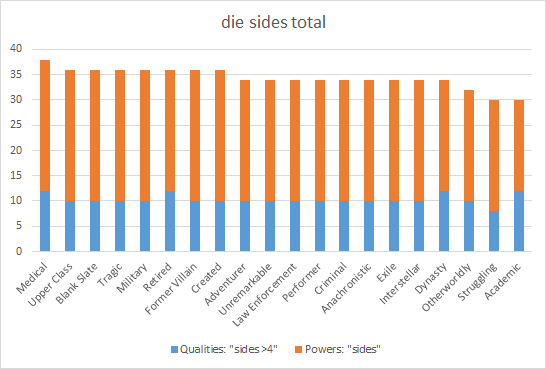
I like Slickriptide’s idea of counting die sides to evaluate mechanistic proficiency, so I went and crunched numbers based on that.

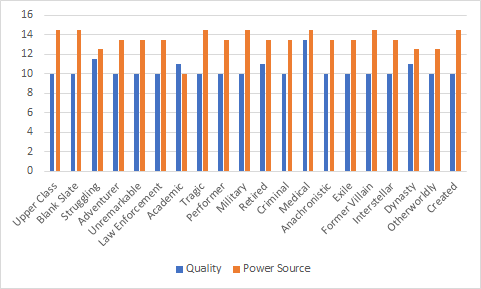
Firstly, I went and checked how many die sides each background gave. Since Qualities always default to 4, I only counted die sides “above 4”.
image
Unsurprisingly, Struggling comes last - but shares that place with Academic. But then, Academic makes up for its smaller dice by also giving a whopping god-like d12. On the other hand, Medical looks much stronger than one would expect for getting a few more pips at the lower end of the scale. So maybe the approach isn’t quite right yet.
What’s more, the mere sum of sides does not reflect how big dice weigh heavier than a spread of smaller dice. Remember that you can ususally pick your dice rather freely; and picking your d12 or picking one of your two d6s should make a tremendous difference!

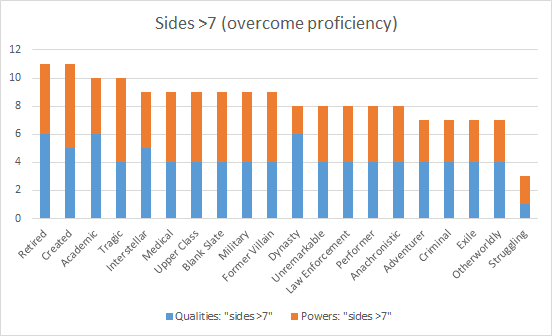
However, if we consider that the moment for a Hero to be at their best is meant to be when using their Principles, and if we then also consider that the pivoting point for a successful Overcome (that is, without adding complication) is “roll 8 or better”, it might seem helpful to have a look at how much die sides of “8 or better” each background brings.
And suddenly, things look quite drastic:
image
(Edit: re-uploaded to sort by size)

Anyhow, if we could get past the “should we do balancing at all” for a moment, I’d really love to hear your thoughts on how you would balance, if you were to do so, even if only for the sake of the argument.

GO
Godai
2021-07-06 15:27 UTC (in reply to #68)
#69

That’s a rather clear picture of how much struggle that Struggling has. Thanks for the number crunch!

RA
Rabit
2021-07-06 16:35 UTC
#70

No offense, @der_andere_Jan, but the last chart (removing the d6s) is pretty biased, specifically since one of the benefits of the backgrounds with lower dice is more dice (Struggling or not), and that ignores many of those dice. :wink: (And the justification for using it also makes an assumption that there won’t be bonuses – and there are frequently bonuses. :smirk:)

I’m more interested in seeing a sum of averages, as that gives a better indications of how many dice combined with the size of those dice. If I can make time, I’ll give that a shot…

But I understand the concerns folks have and don’t see anything wrong with GTG addressing them if they want to. As I’d mentioned, it just hasn’t come up in actual game play as a actual problem that seemed like it needed to be addressed. :man_shrugging:t2:

FJ
fjur
2021-07-06 16:52 UTC
#71

Also, Twists aren’t the end of the world.

SL
Slickriptide
2021-07-06 17:05 UTC (in reply to #66)
#72

This is where it would be useful to hear from the game devs about their intentions, rather than attempting to divine those intentions intuitively.

We’re having the same discussions that they must have had between themselves when they wrote the book, yet they wrote it this way anyway. There must be a reason for it.

RA
Rabit
2021-07-06 17:30 UTC (in reply to #71)
#73

Yeah, but I do respect their point that there are folks who don’t play that way and/or play with a close eye on the numbers, so I don’t want to dismiss that.

DJ
der_andere_Jan
2021-07-06 22:47 UTC (in reply to #70)
#74

None taken :slight_smile:
I am aware that this model is very simplistic, and only relates to how strong a background contributes to a character’s strongest suit, in the isolated situation of using a Principle to Overcome without making things worse.
Considering that Principles and their related Overcomes are the defining traits of a character, this doesn’t seem overly far-fetched. Naturally, this is still only a very small piece of what gameplay will entail! I also did not factor in how the following steps of character creation might turn things around; otherwise the math gets quite unwieldy.
It is really only an abstract statistical modelling certainly not covering every situation, but trying to measure the various backgrounds’ starting points against the gist (imho) of a Character’s proficiency, Principle-based Overcomes.

I did not include boost or twists, because they trade success for complication, in that they require spending resources at another point; this moves the imbalance around, but doesn’t negate it.

Simplification aside, I think it still nicely shows that -when it comes to Principle-based Overcomes- the Struggling background contributes very little to begin with, just to illustrate my point that from that point of view, asking for some counter-balancing might be a valid demand (which I had hoped to find inspiration for here).

By the way, another model I had toyed with was die classes, which is not too far from your idea of the sum of averages.
The math is uglier (don’t let me stop you though), but it eventuallly boils down to this:
There are four type of dice available for characters: d6, d8, d10 and d12. Let’s say d6, d8 are the lower class, and d10, d12 are the higher class.
Backgrounds give 5, sometimes 6 dice, and most provide 2 (rarely 3) of those dice in the upper class. Three provide only one in the higher class, instead offering a very constant spread of d8s and nothing below that.
Struggling now not only provides no dice at all in the upper half, it also gives half of its 6 dice at minimum size (d6)!


It’s a little less graphically obvious (and you’ll have to remember no dice can be smaller than d6), but I think the conclusion about Struggling consequently offering lower dice is not really depending on the math model :slight_smile:

I would agree that in a more restrictive skill system, having or not having a skill can make a lot of difference - but in SCRPG, where stretching the narrative is the core of the game, I don’t think so much. I personally think that in a game where you can usually pick your dice freely, and where a Quality at “no die” equals a d4, one single d6 makes for a rather poor trade instead of even one single strong die.

Yes, that would be very helpful. As it stands, we do not even know whether or not they even discussed it, and neither can we fathom if the ‘reason’ is perfectly though-out and gameplay-related, or just grew upon “more important things to bother with” :slight_smile:
Sadly, the gods chose not to reveal themselves to us (yet).

What we can do, though, is discuss what we deem appropriate houserules. :smiley:

RA
Rabit
2021-07-07 02:18 UTC (in reply to #74)
#75

I don’t disagree with you on the numbers. :slight_smile: But here’s the diagram I was talking about: Summing the dice averages. I think it provides a more interesting look at the overall dice available to the backgrounds. It does also show that Struggling is low on the Power Source side, but it’s actually pretty high on the quality side, which I found entertaining. :blush:

That’s not really how I’ve experienced it, but everyone plays differently. For example, in our games players have to be able to narratively justify the use of a die, which isn’t always as easy as you might think. :wink: Plus folks in our games rarely if ever consider using a d4 – they’ll defer to a comrade who is better at that task or come up with a different approach, instead. I honestly think I’ve only ever seen it once! But again, that’s our games. :relaxed:

The topic has been submitted (at least once! :wink: ) for the up-coming SC RPG podcast episode, so we’ll see if it’s picked up. :smiley:

I think that’s a great idea! Please do, and I hope everyone has a great time talking through it. :smiley:

Have a better one, folks!

GO
Godai
2021-07-07 07:29 UTC (in reply to #75)
#76

I think the easiest house rule, if you think you need one, is to have Struggling give you a d10+d8+d6 for Power Source, instead of d8+d8+d6.

DJ
der_andere_Jan
2021-07-07 07:41 UTC (in reply to #75)
#77

True, different folks… and I suppose every group will soon sort of fall into common habits of valuating dice pools. Seems funny to me that they should make the cut between considering it a valid option and deferring between a d4 and a d6, but then there’s nothing wrong with that either!
On the other hand, I’ve literally seen an attempt to justify flying an airplane with an Info Quality’s inherent typewriter skills (“I’m used to navigate lots of buttons, and they’re all labelled clearly anyway!”), so I guess it very much depends how silly of a stretch your group would be willing to go for. :smiley:

EDIT:

It certainly looks that way. The impression goes away when you factor in that Qualities default to d4 when not explicitly given, so we must theoretically add a d4 for every Quality not mentioned - or, much easier, subtract the d4 from every Quality given.
As you have it now, the extra d6 would weigh all 6 sides (or 3.5 in average results) more than the respective d4, which isn’t accurate. (this does not apply to Powers though)

FJ
fjur
2021-07-07 15:09 UTC
#78

Did that actually work‽

DJ
der_andere_Jan
2021-07-07 16:09 UTC
#79

That player was making that up as an example when introducing a new player - to emphasize the ‘dare to be bold’ notion.

In a real game situation… it would probably need to be a really, really convincing explanation. Then again, we’ve all seen cheesy plot twists in Superhero movies (what, your mother’s also named Martha? Ok then, let’s end our pointless feud!)
Maybe I’d put it to the vote of the table. :smiley:

RO
Ronway
2021-07-07 23:57 UTC
#80

I want to throw in my 2 cents.

Overcomes have 100% chance of success without penalties being in play. That too me says that die size does not matter a lot of the time when it comes to Overcomes. Less than 8 on the effect die does result in some sort of twist, but I do not find twist to be completely bad in these circumstances. When a player gets a twist, either from an Overcome or an ability, I like to get the player’s opinion first. I’ll go ahead and use the twist if it works and is better than what I can come up with, meaning twist are as bad or good as the player makes it. I also like narrative twist more so than mechanical twist. This leads me to give a twist that will further a character’s story. If nothing is coming to mind at the time is when I will go ahead and just hand out a penalty or damage.

One example being I have a player whose character had been missing for roughly 10 years. Now their back and have yet to contact any family. A lot of his family’s wealth was spent trying to locate him and they were originally pretty well off. Using a twist one of his siblings is now a thief because they were used to a certain lifestyle. After seeing the player’s character on the news the sibling will track him down and try to use him for his own benefit.

Another character is super into being a hero and likes to check articles to see if he has been noticed. Sometimes when a minor twist shows up I like to use it to say he was accidently left out of all articles related to that event.

How bad of twist are players seeing where they have decided that they must roll an 8?

CH
Chaosmancer
2021-07-08 01:46 UTC (in reply to #80)
#81

Well, I haven’t used a lot of twists yet, but damage or penalties is fairly rough. Even min damage can be 3 or more which is 10% of a player’s health.

Also, a penalty can mean that they are more like to get a worse twist the next time, which can spiral.

I’ve also seen between 2 and 8 minions added to a scene because of a twist. This skews the battlefield very much in the villains favor, causing more damage, more hinders, and may slow down achievement of the main goal. Same with Lieutenants, though usually that is just a single lieutenant.

In a similar vein, you can end up with a new overcome challenge, such as civilians in danger or a doomsday plot and that can delay the characters significantly. I actually did use this once and got the people involved a little miffed, because a major twist let to the villain having wired the place to explode, and the characters had to deal with a suddenly much different scene than they were in before, and nearly didn’t make it in time.

You can also lose access to your powers or qualities for an entire session, losing the main way you interact with your character, such as a fire character losing their fire powers is fairly devastating if it happens early on. Great RP potential, but it presents a line that is tricky to deal with.

Yes, twists aren’t bad. Twists can be great and the examples you gave are great uses, but there are also many many uses for twists that can lead to the team getting delayed to the point of failure. Especially if you are triggering twists more often than usual, and end up triggering a spiral.

LO
LonelyMan
2025-12-05 23:51 UTC (in reply to #68)
#82

A character who’s been Struggling their whole life is still in the present unlikely to have an easy time Overcoming things … hm, do tell…